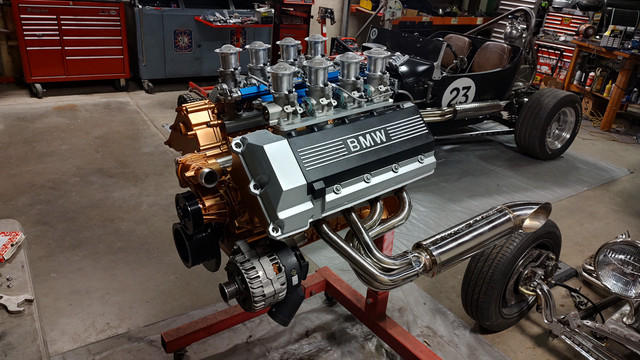


Beautiful design and creation. Well thought out and all makes sense.
I haven't seen any caps on the feed side, but haven't dug deep on modern stuff for a while.
I fully understand that you are going full on into max performance and I tend toward a KISS approach.
So these are possibly dumb questions.
I remember 'scoping cars in the shop and also shop class on how coils work. A coil will only produce the minimum amount needed to complete the path. It might be rated for 60K, but at idle no load, it will only produce 5-15K. Under hard acceleration, heavy load and especially with forced induction the demands rise. It usually takes a lot of each to require more than a well sized coil with a good power and clean ground trigger. This is especially true when comparing old single coil systems to modern coil on plug applications.
You are going above and beyond, and I am enjoying following along. You haven't shown data logs and I would be like a 1st grader reading PHD dissertations anyway.
But I wonder First how often is this dipping into high demand situations? Very light car with well refined HP engine on the streets means a few seconds at most to my mind. I understand chasing that last 1%. Just wondering if it's even that much. That should show up on logs.
Second, are you able to actually see demand per coil or cylinder pressure? Not a derived number, but perhaps crank acceleration? With paired coil triggers on the ground side, I don't know if it would be possible for the PCM to see amp draw from the coils. Maybe a stand alone 'scope on the power side at each coil?
I guess what I'm really asking is are caps actually needed at all? I guess this sounds like someone asking why you need a DOHC and supercharged V8 in a car that weighs under 2 thousand pounds but no fenders! I am not coming at you like that. It just seems like it's adding headroom to an area that has plenty already, like a second oil pump to a well designed setup.
I admire and appreciate stuff that has designed in worst case and above expected use, like engines that can be modified to deliver reliable power increases without major rework. Transmission design and selection that can support more torque than the stock engine, not requiring the engine to be detuned to survive (Espirit V8).
I also think some places where simple and reliable need added complexity. I have watched lots of Matt Armstrong's videos and wonder why light unsealed electronic controls are placed at the lowest point in a tub (lots of supercars) or why the Bugatti requires splitting the chassis for a lot of servicing but does not have a main harness connector at that point.