

Garage Merch                Ron Pope Motorsports                California Custom Roadsters               

Home made frame

anesthes

New Member
Building or I should say re-building a frame.

I had a narrow frame (22.5" outside) and it rubbed the bell housing, made it impossible to mount a brake master, etc.

I want to keep the front crossmember/spring perch, so I cut it off and I'm rebuilding the main rails.

I have two options:

1) Taper from 22.5 to 26.5 at the rear kickup which would be about 86" from the front crossmember
2) Taper from 22.5 to 26.5 at the FIREWALL, and then maintain a 26.5 rectangle from the firewall to the rear kickup. (37.5" of taper)

Which would you do ?

Dimensionally, I'm thinking of setting the centerline of the engine mount at 19.25" from the front crossmember, which will give me plenty of room for the vega box (cross steer).

I'm running a 23 body with a turtle deck. I was thinking of adding 4-6" in the cowl to give a little more foot room.

So that would put the bell housing at 35.25" from the back of the front crossmember. I'd run a 2" gap between the bell housing mating surface and the firewall.
So a typical 23 body is 42", add 6" for a firewall extension that puts the body at 85.5" from the back of the front crossmember. Then we do the rear kickup, and rear part of the frame. The turtle deck is 36".

I think this ends up being about 116" wheelbase car if my math is right.

Anyway. Feedback appreciated.
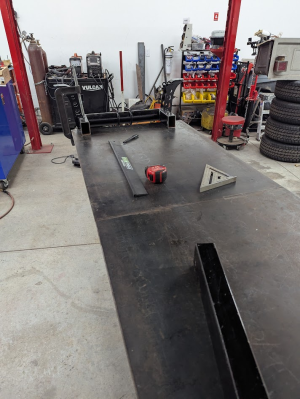
1765295493680.png
 
I think I would prefer the taper-to-the-firewall option. It would give you potentially more interior room between the frame rails. Will you use a kick-up in the front to get that in-da-weeds look?
 
I think I would prefer the taper-to-the-firewall option. It would give you potentially more interior room between the frame rails. Will you use a kick-up in the front to get that in-da-weeds look?

You know, I saw a couple of frames like that. It's an interesting look. I think if I was using a model A front crossmember with spring over I'd do it.
 
First part, taper thru entire length or just to firewall. Then you provide a measurement of 26.5 inches either way.
I didn't go out and measure mine, but the critical measurement is AT the firewall. I did find this online. 27.5 inch.
Now maybe this is a big boy body that is stretched and widened.
t dim.jpg

I have seen frames narrower than the corners of the cowl, the exact width (but inside the body, so subtract about 1/4 to 1/2 inch for the thickness on each side) and even wider. Almost all subscribe to the width of the bottom of the cowl. It's kind of a thing, like pants fitting at the hips.
Double check this measurement on your body.
Look at a ton of these, paying attention to where the frame and cowl meet.
There are a LOT of pictures here.

You didn't mention channeled or not. That typically follows this same style choice, but does allow some 'fudging'.

1) Taper from 22.5 to 26.5 at the rear kickup
Having the 26.5 you mention at the back of the frame would still be narrow at the firewall which is where your issue is. That doesn't make sense.

So, I will ignore the geometry and angles and say that the frame rail should be wide enough to fit the components and the body at the firewall. Using the same front crossmember is going to require a taper at the front (narrow) to the firewall (wider).
Most T-Buckets use a suicide style front, not a Model A crossmember. Look for that in the pictures too. If you go with a track T style and a nose, this could hide the Model A crossmember. Note this body has a 1927 cowl, so it's wider.

OIP.jpg


A kickup like Spanky mentioned is a reference to a Z, where the frame is stepped in back and in front.
This isn't a T frame, but shows the idea.

frame5.JPG
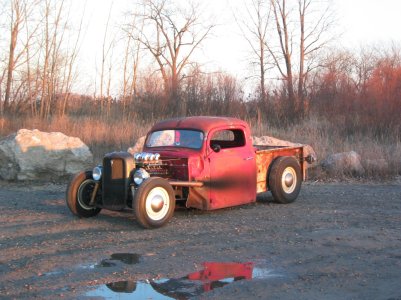
And here's a pickup with that sort of frame. You can see the frame rail 'dip' just before the firewall.
IMG_0040.jpg
This does provide a lower stance, and more room in the cab since the frame rails 'dip' under.
It will require more careful fitting of parts, since the frame changes height.
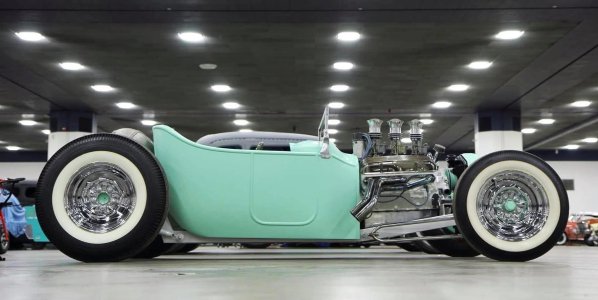
Here's a T with the typical kickup in the back, but the front is angled. This is another way to lower the ride height without the frame intruding up inside the body as much. You could achieve this with a Z or step at the firewall.
aqu t.jpg
I will say that if possible, get all the major components and set them up on your frame table, then stand back and look things over.

That ought to get you started. There are a lot of resources for frame plans, but it sounds like you are working to your own beat.
If you want to check out plans
 
Last edited:
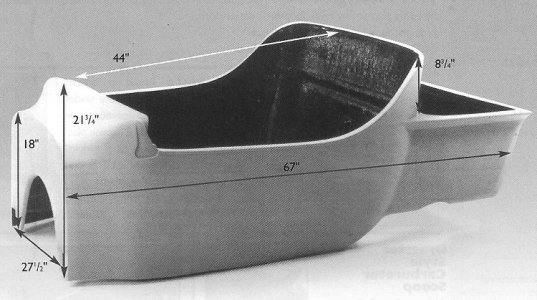
The picture of the bare body with the dimensions shown above is a total performance anniversary body. It's longer than the Total Performance standard body but the width at the firewall is essentially the same.

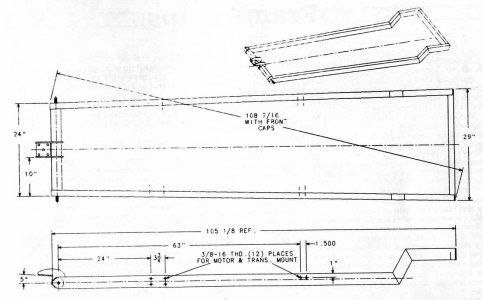
total performance frame dimensions.jpg

For reference, this is a picture of the Total Performance frame. It a single tapered frame that is 24” OD at the front and 29” OD at the rear. When measuring the outside diameter of a chassis, remember that the width of the tubing used to build the chassis can affect the inside diameter measurement. Total Performance, Speedway and the Youngster chassis all used 1.5”x 3” tubing, where many of the other chassis are made with 2”x 3”. If the OD measurements are the same, a frame made with the 1.5”x 3” would have 1” more inside diameter clearance for your bell housing, starter, alternator, etc. than a frame made with 2”x 3” tubing.

Unless your limited for some reason to the 26.5” rear width and since you’re rebuilding the main frame rails anyway, you could make it whatever width you want. I think that many of the frames are made 26.5” because it gives you plenty of clearance in the engine area and fits the front of the body. It’s also easier and less work to keep the frame the same width from front to back.

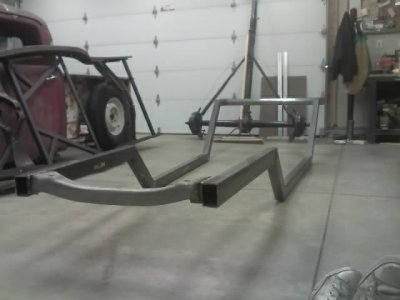
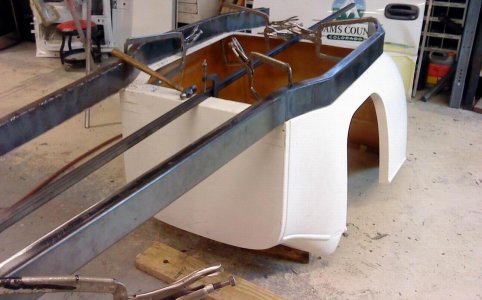
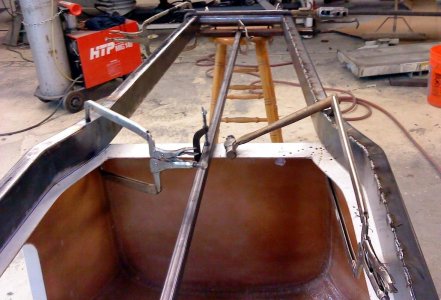
Here is a couple of pic’s from the web showing a frame that follows the body and then kicks back in at the rear. There are lots of ways of doing things.

1m.jpg1n.jpg
 

     Ron Pope Motorsports                Advertise with Us!     
Back
Top