


You are using an out of date browser. It may not display this or other websites correctly.
You should upgrade or use an alternative browser.
You should upgrade or use an alternative browser.
Points ignition
- Thread starter Spanky
- Start date

Martin72
Member
I'm still using ignition points on all my old cars ('27 Roadster, '31 Model A, '60 Harley and '72 Corvette). I still using them mainly due to simplicity. Easy to adjust points, clean points, etc. And....much easier to trouble shoot no spark issues on the side of the road. I'm not against electronic ignition, just haven't wanted to make something simple more complex. I guess if I wanted more of a hot rod, throw on a blower, dual carbs, nitrous, etc., I would consider EFI and electronic ignition with the ability to integrate all the systems, control timing based on boost, etc.How many of us are still using ignition points instead of electronics? And then the question, why? I know some of us are old school and like the old methods but what are your reasons for choosing your ignition system?
Right now, I'm happy just puttering around with a simple system.
death trap
Member
I'm running a mallory dual point distributor a blast resistor and a generic coil. My old employer has a distributor machine we ran it on. It seems to start better, quicker with points. I want it to be like it was built in the sixties. Fewer wires and easier to fix.

RodStRace
Active Member
Currently running an MSD box and dist. Because that's what it had when bought and it works.
Not a huge fan of them, they work well when they work but troubleshooting is "replace with known good unit and retest" and no side of the road repair.
It's like anything, go with what you know and are comfortable with, in the budget.
I don't trust modern replacement ignition parts, so I'd have to track down new old stock stuff to go back to points.
At least AC Delco uniset D1007 is still made in the USA.
Currently have other fish to fry, so will stick with it until it croaks or it's climbed to the top of the list.
Not a huge fan of them, they work well when they work but troubleshooting is "replace with known good unit and retest"
and no side of the road repair. It's like anything, go with what you know and are comfortable with, in the budget.
I don't trust modern replacement ignition parts, so I'd have to track down new old stock stuff to go back to points.
At least AC Delco uniset D1007 is still made in the USA.
Currently have other fish to fry, so will stick with it until it croaks or it's climbed to the top of the list.

thebearded1
Active Member
I'm running points since that's what the engine has and I started and it hasn't given me any issues since. I've thought about doing an electronic conversion but it just seems like more areas to fail.
I will say it is getting harder to find quality replacement points and condensers.
I will say it is getting harder to find quality replacement points and condensers.

RodStRace
Active Member
Well, let's take the SBC points dist VS the stock HEI, since most of these run that engine.Just remember with a no maintenance electronic ignition system; there is no maintenance possible when it breaks down on the side of the road.
Points have 2 leads; the ignition switch feed with a resistor wire and the starter bypass feed. The HEI only has the switch feed.
Resistors rarely fail and it will still start with the switch feed, but more to troubleshoot.
Ignition coil is a R&I in either case. Pretty much even there.
Service parts like vacuum advance and shaft bushings about even too, but the points have spring force on the shaft. These should not be roadside fixes. ignition coil negative wire is shielded by the coil cover and short multi wire pigtail from cap to dist.
Changing points and condenser or uniset compared to module is roughly the same as far as spare parts size and effort. Considering wear on points, I'd give the module the nod here. Yes, the points can be serviced with sandpaper and a matchbook, but I'd say that is more effort over time than the module.
Cap and rotor are bigger for the HEI, but the difference isn't so bad you have to tow a trailer.
Tools for the job are roughly the same. Points needs a flat screwdriver, Phillips (rotor), wrench for the points lead and an Allen to set the point gap, plus the sandpaper and matchbook. HEI requires a flat and phillips, plus a 5/16" nutdriver for the cap, coil, and module. Slight lead for HEI.
In either case, a complete drop-in can be carried, which are roughly similar in size.
If you start getting into aftermarket EI, like MSD or Pertronix, I will agree that troubleshooting and roadside repairs are much less likely.
So overall if you can live with a bigger distributor like the HEI, it offers proven reliability and the same or better servicing. Hotter spark and better wires come along for the ride.
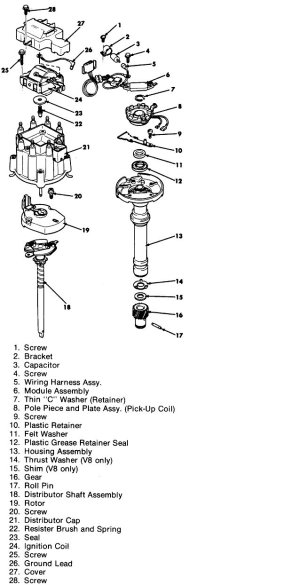
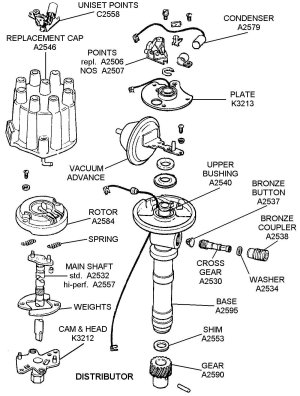

So overall if you can live with a bigger distributor like the HEI, it offers proven reliability and the same or better servicing. Hotter spark and better wires come along for the ride.
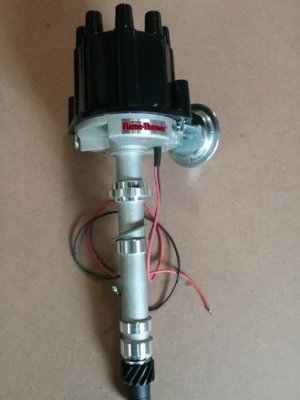
I have the best of both worlds . . . A Pertronix "small cap" Flame Thrower electronic distributor. Fits nicely close to my firewall, but not touching it.

Indycars
Well-Known Member
I have a MSD distributor all in one. It failed once, so I bought a cheapo of eBay to test with. When it ran OK, then I replaced the module.
Any time I leave town for a big trip, I threw that distributor in the trailer. I always had a way to get it running again after that. eBay has one with small cap for $50, how can you go wrong for a cheap backup.
.
 .
.
Any time I leave town for a big trip, I threw that distributor in the trailer. I always had a way to get it running again after that. eBay has one with small cap for $50, how can you go wrong for a cheap backup.
.
Sbc Distributor Small Cap for sale | eBay
Get the best deals for Sbc Distributor Small Cap at eBay.com. We have a great online selection at the lowest prices with Fast & Free shipping on many items!
www.ebay.com
Last edited:
Indycars
Well-Known Member
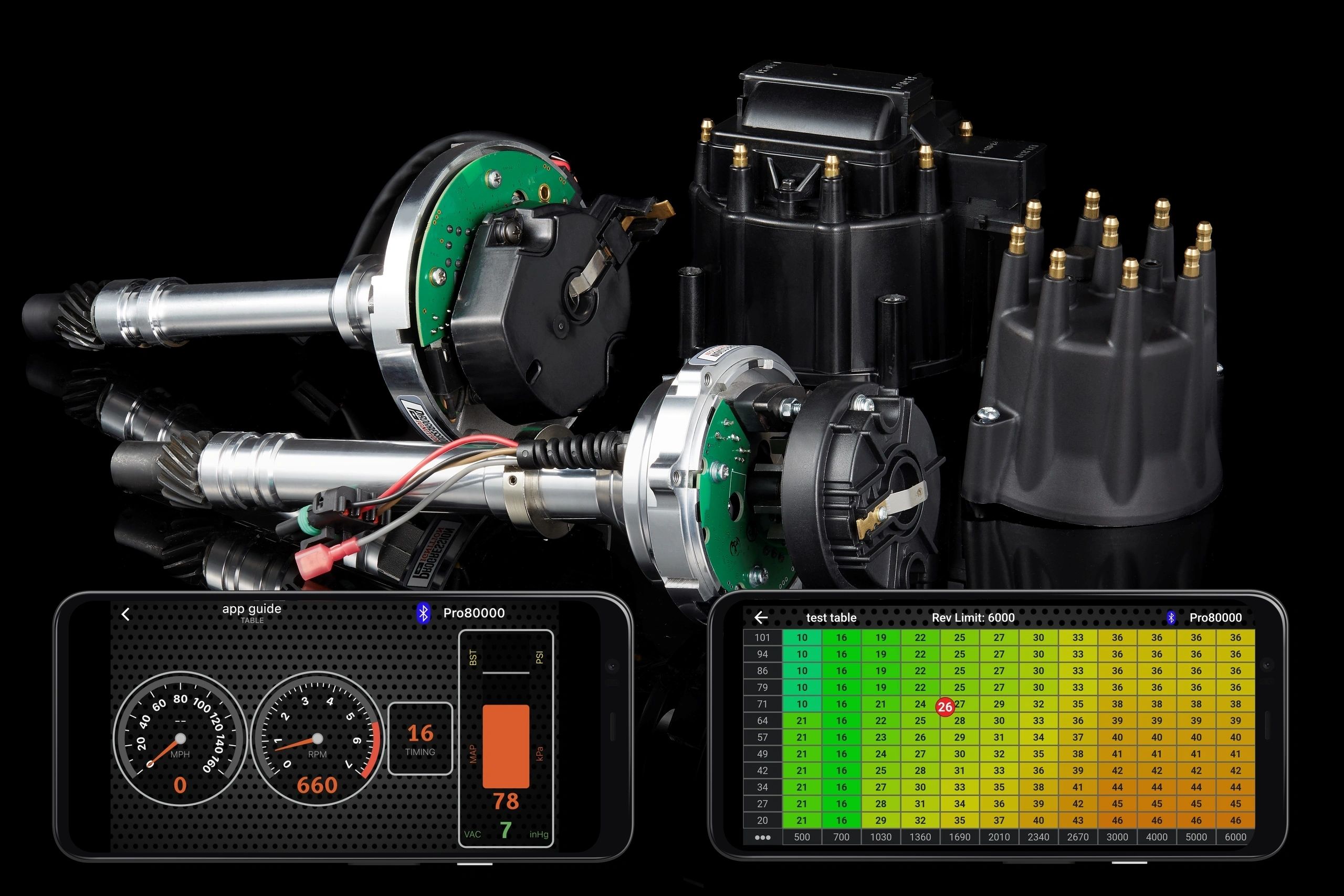
I'm a techie, so this is what I would buy nex time.Right from your phone bluetooth adjust most anything on the fly IIRC.
 progressionignition.com
.
progressionignition.com
.
Progression Ignition
Fully electronic timing control. Tuned with your smartphone or tablet. Wireless Bluetooth connection
progressionignition.com

RodStRace
Active Member
The Petronix is a small powerful package. The issue is if/when it fails. Not easy to troubleshoot or repair.
On the HAMB, there are at least 4 to 6 posts a year asking for help on this.
The HEI has a simple R&I for the module, the P does not due to it being hard wired without a connector.
The module is as easy to replace aside from the wiring, but more expensive.
The pickup appears to have a single reluctor, rather than 8. Both require disassembly to change. See part #8 in the exploded view in past post.
The HEI pickup has proven to be very reliable aside from the V6 version, which gets corroded - probably due to lack of venting and small diameter.
When selecting one, the HEI just needs a single 12V source. The rest is integrated in the package. The P requires matching coil or coil/ballast package and digging into the car wiring. Not a big deal if you are familiar with electrics and wiring your T, but extra steps that can trip up the install and use. This shows an install .pdf. It explains what is required for the install, but does not lay out simple, 'combo A, combo B, combo C' choices.

 pertronixbrands.com
It's a good solid choice, but only if you are adept at electrical understanding. It also is a pain to swap the module because they chose not to have a connector where the 2 wires go through the housing.
The HEI has been copied and there are very poor quality offshore copies flooding the low cost market. Buyer beware.
On the HAMB, there are at least 4 to 6 posts a year asking for help on this.
The HEI has a simple R&I for the module, the P does not due to it being hard wired without a connector.
The module is as easy to replace aside from the wiring, but more expensive.
The pickup appears to have a single reluctor, rather than 8. Both require disassembly to change. See part #8 in the exploded view in past post.
The HEI pickup has proven to be very reliable aside from the V6 version, which gets corroded - probably due to lack of venting and small diameter.
When selecting one, the HEI just needs a single 12V source. The rest is integrated in the package. The P requires matching coil or coil/ballast package and digging into the car wiring. Not a big deal if you are familiar with electrics and wiring your T, but extra steps that can trip up the install and use. This shows an install .pdf. It explains what is required for the install, but does not lay out simple, 'combo A, combo B, combo C' choices.
PerTronix Stock Look Distributor for Chevy Small Block/Big Block Engines
Features & Benefits All new lightweight cast aluminum housings modeled after the original distributors.
pertronixbrands.com
It's a good solid choice, but only if you are adept at electrical understanding. It also is a pain to swap the module because they chose not to have a connector where the 2 wires go through the housing.
The HEI has been copied and there are very poor quality offshore copies flooding the low cost market. Buyer beware.

Fun story: at a big meet and a guy couldn't start his car. He was non-tech, so me and another guy jumped in. Turned out the points were so worn that they could barely open. We had the PA guy ask if anyone had the points for a Chev dist. Got them and fixed the problem. Thought the owner was gonna kiss us.
Similar threads