Garage Merch                Ron Pope Motorsports                California Custom Roadsters               

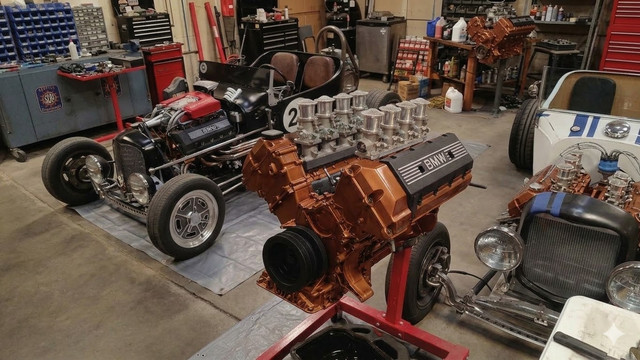
Mykk's BMW V8 T-bucket, version 1.5:

That is a beautiful engine. I admire your skills. I can barley do anything to an vintage chevy engine way above my pay grade.


I'm thankful there is no demand for these engines and there are so many of them produced, I pick them up for a couple hundred bucks and you see I don't tear into the rotating assembly. All the shiny new bits are Ebay & Amazon.
 
I think we are witnessing an epic build thread here, folks! For me this ranks right up there with Choppinczech's roadster body build. One for the archives.

 
Last edited:
I agree with @Spanky - Love watching this build coming together.
Way above my knowledgebase to be able to do this!
 
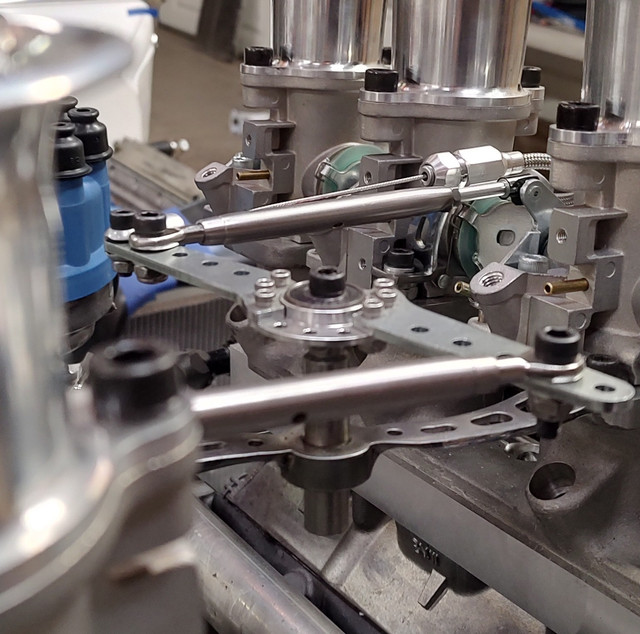
Mykk, I notice that you have the spring clip over ball joint at the throttle bodies. The inner arm connections look different.
Can the inners snap off easily to pivot out of the way to service the injector rails? I guess the whole linkage pivot might not allow the rails to lift up and out.
 
Mykk, I notice that you have the spring clip over ball joint at the throttle bodies. The inner arm connections look different.
Can the inners snap off easily to pivot out of the way to service the injector rails? I guess the whole linkage pivot might not allow the rails to lift up and out.
You are correct. I even made/modified new rods this morning using old boat turnbuckles.


If & when I need to access the fuel rails I suppose I could unclip the rods from the throttles and remove the bellcrank pivot bolt then remove the whole thing.
 
Are the holes in the bell crank for adjusting the ratios or just cosmetics?
 
Are the holes in the bell crank for adjusting the ratios or just cosmetics?
It's a universal throttle bellcrank to adapt to whatever you're building so I'm sure the holes are just to open up options. Changing holes would absolutely effect the throw ratio and make the throttle open faster or slower or harder vs softer. I just chose the holes that gave me a straight throw to the throttles.
 
I was thinking that the spring clips would be better on the linkage end. Pop them off and swing the arm up for servicing, since the throttle end pivots in a vertical plane. They probably aren't a tight enough tolerance for ITBs and computer control, though.

It's these little changes and refinements that take a ton of thought, time and sourcing but make for a much better final product that most people don't even notice.
 
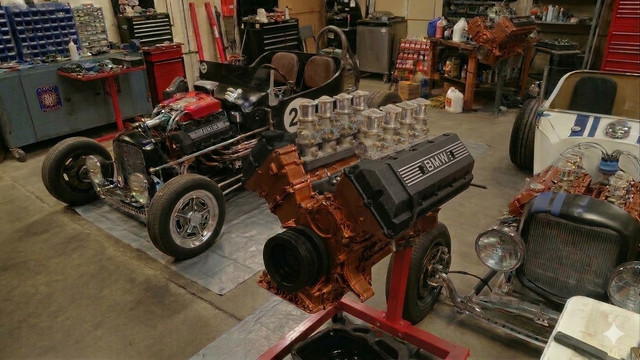
I'm not naturally a proponent for AI, but I figure I can use it for the tool that it is.

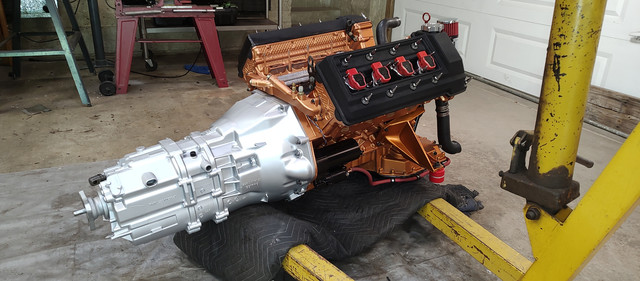
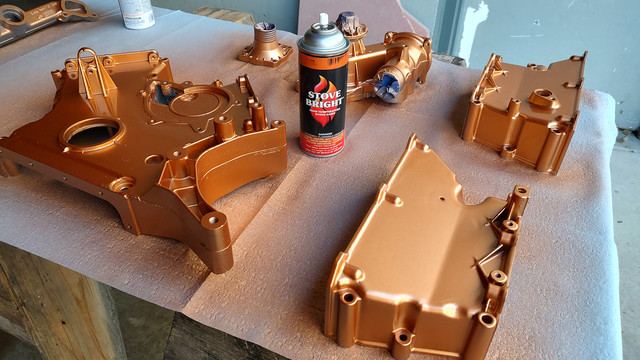
When I painted Bucket #1 I used Stove Bright high temp copper and was really happy with the color. I ran out of cans of Stove Bright and used VHT Burnt Copper to finish and that didn't turn out as well as the Stove Bright. As you can see from the block & heads (Stove Bright) and motor mount (VHT)


So this go'round I've stocked up on a case of Stove Bright.


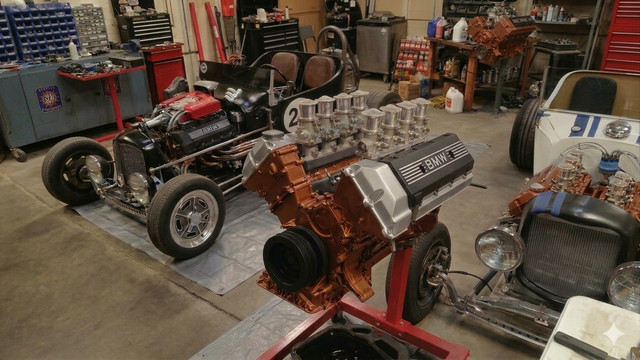
Asked AI to cycle the valve cover colors for me. I originally planned for Silver (if not polished) to be the Ying to the first builds Yang. But after seeing it I'm thinking wrinkle black will win again.


Started painted some stuffs, for real this time.


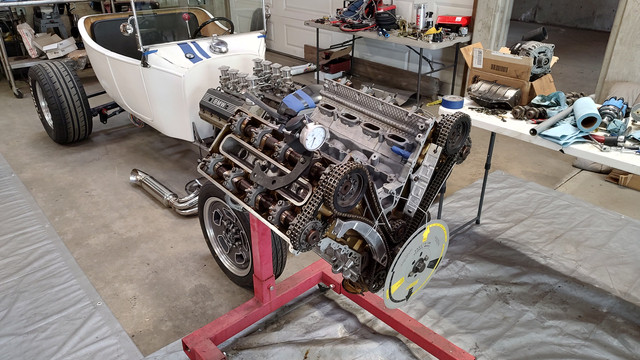
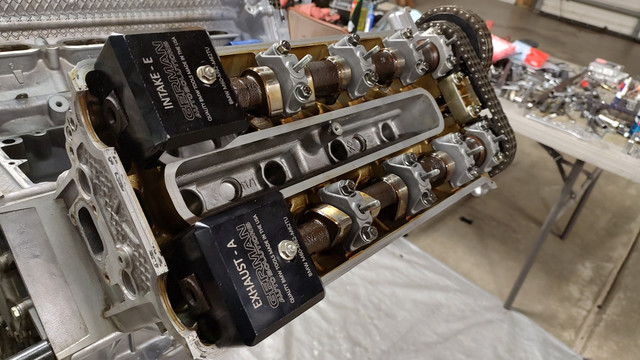
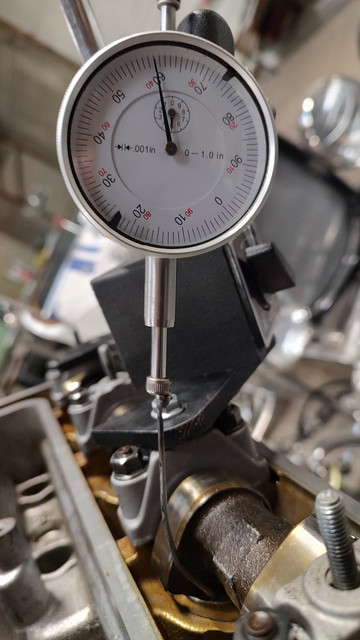
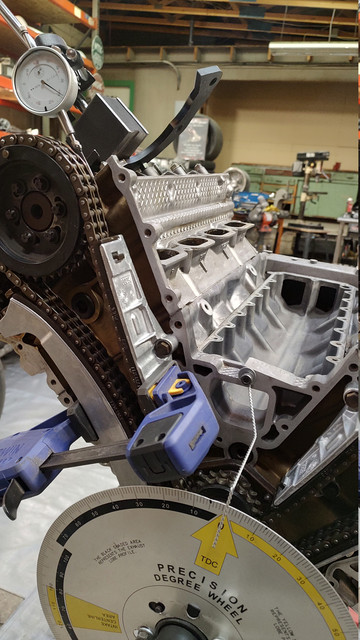
The timing guides arrived. Now the that engine can turn the cams around I installed the degree wheel, found true TDC with a piston stop and zero'd out the pointer.

It's all of impossible to get the dial indicator on the face of the lifter through the full rotation. So I thought I'd get smart and measure the cam duration on the cam lobe, then only measure the valve open event's on the lifter and put the two together.


The cam durations were just not adding up. I was getting like 20+ crank degrees less duration then the literature states these cams should be at.

Then it dawned one me, the cam lobes wipe across the face of the lifter. Having the cam lobe ramps start and end at different locations of the lifter face will increase the effective duration...and there would be no way to measure that without getting the dial indicator on the face of the lifter for the full rotation.


I'll use the published camshaft data of Intake: 211 Duration @ 1mm/0.040" - Exhaust: 207 duration @ 1mm/0.040". On the dyno sim the best power and torque for this combo is 110 ICL and 108 ECL / 109 LSA. Using the 0.040" cam spec IVO is 4.5 degrees ATDC and EVO is 31.5 BBDC. Then keep my fingers crossed the published data matches the actual cam.
 
Option one, make a jig that holds a slug the same width of the bucket and measure at top of the head and subtract degrees from down to up. Pain unless it all bolts well to hold the tolerance needed.
Option two is to pull a head and measure directly on the valve face. Pain due to disassemble/reassemble. Do you have a spare head? That would allow using it as a fixture to check each lobe of each cam. Just use light springs.
 
I'll use the published camshaft data of Intake: 211 Duration @ 1mm/0.040" - Exhaust: 207 duration @ 1mm/0.040". On the dyno sim the best power and torque for this combo is 110 ICL and 108 ECL / 109 LSA.
That seems like a pretty mild cam, though I understand that the duration measurements are at .040" lift, and not at .050 the way most domestic cams are measured. My mild flat-tappet hydraulic cam is 218/224 degrees at .050" lift. (110 LDA)
 
I do what I can with stock cams on these engines. Aftermarket cams for this engine are prohibitively expensive. The OE cam in my GM truck with a 5.3 is 196/201 @ .050" and has a 116LSA, and it moves my 5k-lb truck pretty darn well for a 323ci small block.
 
Spanky, it's kind of apples to oranges. Direct acting DHOC versus cam in block with rockers. Plus a fast burn head and ports that probably have flow and velocity domestic V8s wished they could get.
On top of that, BMW has been advancing engine management tech for decades. They were adjusting individual spark timing back in the 90s or earlier.
The 2000s 7 series didn't have a throttle body for driver requested RPM. They controlled intake valve opening for engine speed.
Then the intake was an inner and outer scroll to adjust intake runner length to suit RPM, building a high, flat torque curve thru the range.


That cam timing stuff really is amazing all on it's own. I haven't dug deep on it, but if they can time events to hold RPM, they can probably 'pause' the cam a bit at lift for each valve and create more duration.

MKykk, I don't know enough to ID yours and see if this is the one you have chosen to explore. I barely know any designations and these kids keep tossing multi letter and number stuff out.
 
Last edited:

     Ron Pope Motorsports                Advertise with Us!     
Back
Top